
Bearing Basics
What is a Deep Groove Ball Bearing?
Deep groove ball bearings are versatile rolling bearings for radial and axial loads. They are widely used in electric motors, household appliances, industrial equipment and many other applications.
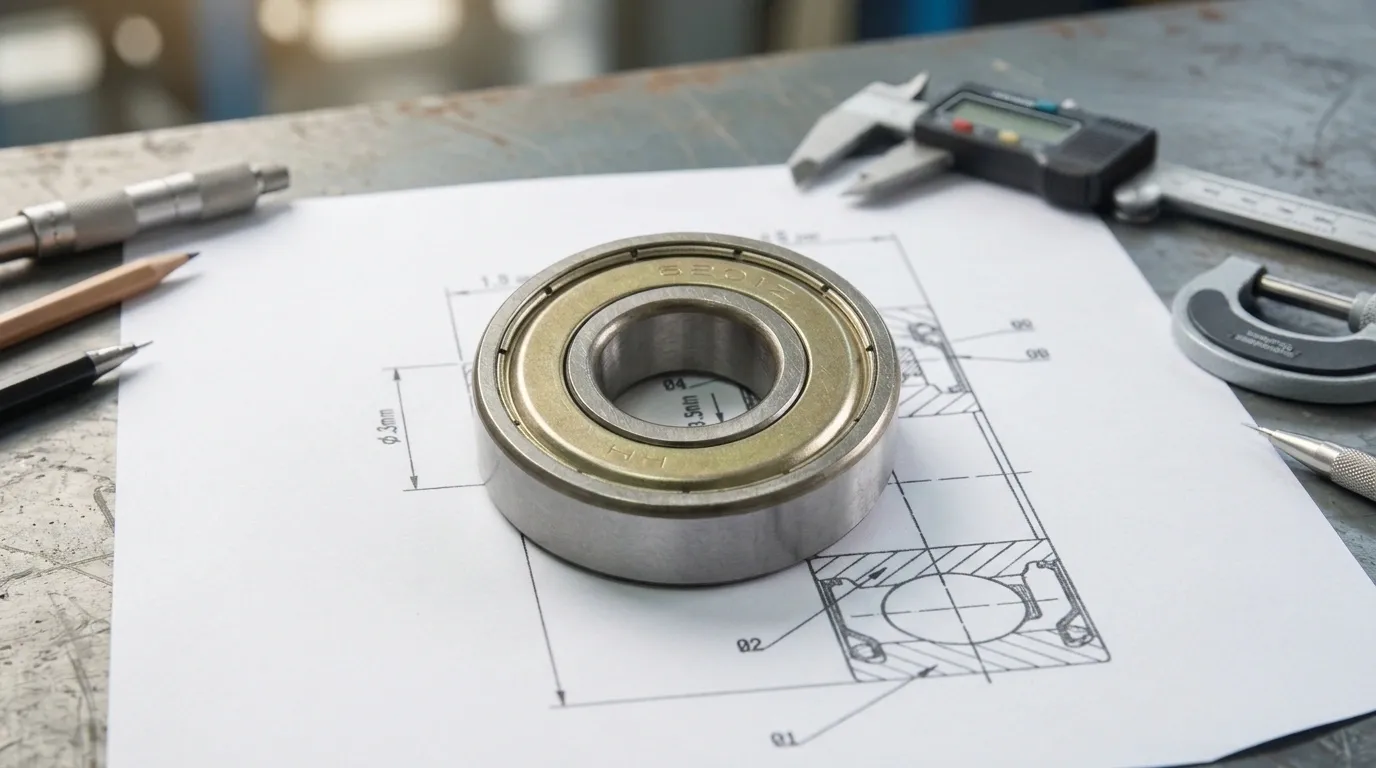
What is a Deep Groove Ball Bearing?
A deep groove ball bearing is one of the most widely used types of rolling bearings. It features deep, continuous raceway grooves in both the inner and outer rings, with balls rolling between them. It is designed mainly for radial loads, while also accommodating axial loads in both directions.
Basic Structure and Components
A deep groove ball bearing consists of four main components:
- Inner ring
Fits onto the shaft and normally rotates with it.
- Outer ring
Fits into the housing.
- Steel balls
Roll between the inner and outer rings to reduce friction.
- Cage
Keeps the balls evenly spaced and prevents them from coming into contact with each other during operation.
The raceways on both rings have deep, continuous grooves that guide the balls as the bearing rotates. This design allows the bearing to carry radial loads as well as axial loads in both directions.
It is a relatively straightforward construction, but the dimensions, internal clearance, materials and manufacturing accuracy all affect how the bearing performs.
It is worth noting that while double-row deep groove ball bearings do exist for handling heavier loads, the bearings we commonly refer to and the ones primarily discussed in this article are single-row deep groove ball bearings. Featuring just a single row of balls, the single-row design is the industry standard that meets the vast majority of industrial, automotive, and appliance requirements with its simplicity and high-speed capability.
Bearing types, Open, ZZ or 2RS
Deep groove ball bearings are classified by their sealing and shielding configuration into three main types:
Open Type
Open bearings have no shields or seals. They are commonly used in applications where the bearing is protected from dirt and other contaminants, or where lubrication can be supplied by the surrounding equipment.
ZZ – Double Metal Shielded
ZZ bearings have a metal shield on each side. The shields help keep out dust and larger particles while retaining grease inside the bearing. They are commonly found in electric motors and general industrial equipment.
2RS – Double Rubber Sealed
2RS bearings have rubber seals on both sides. Compared with metal shields, rubber seals generally provide better protection against dust and moisture. Most are supplied with grease from the factory and are suitable for applications where regular relubrication is not required.
Where Are Deep Groove Ball Bearings Used?
You will find deep groove ball bearings in equipment across many industries. Some common application areas include:
- Electric Motors
Industrial motors, brushless DC motors, servo motors, and various fractional horsepower motors.
- Household Appliances
Air conditioners, washing machines, electric fans, and refrigerator fan motors.
- Pumps and Fans
Water circulation pumps, industrial ventilation fans, and air blowers.
- Industrial Automation
Conveyor systems, small machinery, and automated production line components.
- Automotive Components
Wiper motors, seat adjustment motors, HVAC actuators, and various small mechanical assemblies.
- Office & Precision Equipment
Printers, copiers, medical instruments, and compact mechanisms.
Deep groove ball bearings are the most popular and widely used rolling bearing type due to their versatile design and reliable performance.
They are popular mainly because of their simple design, relatively high speed capability, and exceptional ability to handle both radial and axial loads simultaneously. Additionally, they are readily available in a wide range of standard sizes and configurations, making them extremely easy to source, install, and replace across various industrial applications.
Whether used in household appliances, electric motors, or heavy machinery, selecting the right deep groove ball bearing depends on carefully evaluating load requirements, speed, lubrication, and the operating environment to ensure optimal service life and efficiency.